Saint Thomas Becket Martyrdom Anniversary
The Last DuelThe Saint Thomas Becket Martyrdom Anniversary gives the judicial combat between Jean de Carrouges and Jacques Le Gris its calendrical and ceremonial setting. On the saint’s feast day, a festive Paris crowd gathered to watch a trial whose verdict would determine not only the combatants’ fates but also whether Marguerite de Carrouges would live or die. The day’s religious observance and public appetite for spectacle occupied the same space, as the case moved from solemn oaths to combat and its aftermath.
Feast Day and Public Stakes
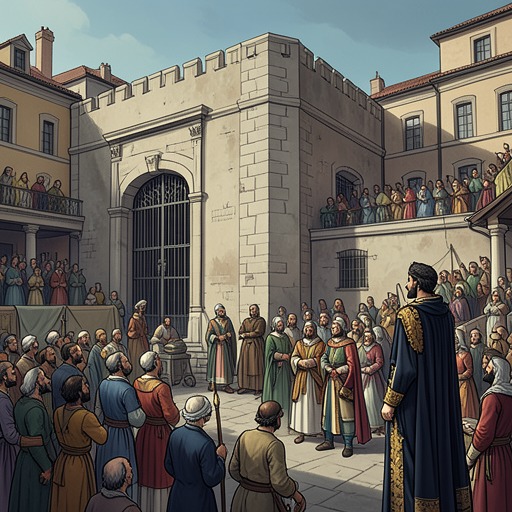
The trial took place on the feast day of the martyred Saint Thomas Becket. The crowd was in a holiday mood, yet many spectators were eager to see both a man killed in combat and a woman put to death if her champion lost. For Marguerite, watching from the field, the outcome would settle whether she went free or paid with her life for having sworn falsely. The feast day therefore framed a public ceremony in which celebration and the possibility of execution were inseparable.
As the bells of Paris tolled the hour, the king’s marshal entered the field and called for silence. His gesture marked the transition from gathering and anticipation to the formal beginning of the trial. The day was not merely a backdrop: its public, ceremonial character made the crowd witnesses to a proceeding whose consequences extended beyond the two men fighting.
Oaths and Sacred Procedure
Before the combat began, priests placed an altar at the center of the field. It held a silver crucifix and a prayer book opened to an image of Christ’s Passion. These objects presented the duel as a divine judgment: the violence about to take place was framed as a means by which God would reveal which party was guilty.
The combatants swore three formal oaths. In the last, they remained kneeling face-to-face, touched the crucifix with their right hands, and clasped each other’s bare left hands while the marshal held their joined hands. Each reaffirmed that his own cause was just and his opponent’s was wrongful. The physical clasp made their opposing declarations part of a single public ritual, binding the adversaries to the dispute even as the religious objects invoked judgment beyond their own authority.
Marguerite also had to swear an oath after the combatants, because she was the case’s chief witness. Her position made the day’s stakes personal as well as ceremonial: the men’s sworn claims and the result of the combat would determine whether she survived the accusation of false testimony.
From Ceremony to Combat
Once the ceremonies and required words were complete, Jean de Carrouges and Jacques Le Gris withdrew to their pavilions. Their attendants checked their armor and weapons, while the priests removed the altar, crucifix, and prayer book. Attendants swept the sand smooth where the altar had stood, leaving the field ready for combat. The sacred objects had defined the proceedings as judgment; their removal marked the shift to the physical contest expected to produce that judgment.
After the combatants signaled their readiness and the gates were cleared, a herald took his place at the center of the field and waited for silence. The trial thus moved through distinct stages—public assembly, oaths, preparation, and the opening of the fight—within the same feast-day gathering. Its ceremonial order did not lessen the danger: the result would determine the fate of Marguerite as well as that of the two men.
Outcome and Aftermath
Jean de Carrouges won, and the crowd’s affirmation carried beyond the old priory into the surrounding district and the streets of Paris. He limped from the field; an attendant removed his thigh piece and bandaged his wound before he proceeded to pay his respects to the king. Charles VI awarded him a thousand francs, made him a member of his chamber, and granted him a lifetime pension of two hundred francs a year. The king also sent a personal physician to tend him.
Jacques Le Gris’s death brought a different consequence. His body was stripped of armor, carried from the field, and delivered to the executioner of Paris, who dragged it beyond the city to the Gibbet of Montfaucon. Under the established customs of the duel, the dead combatant’s body was treated as that of a convicted criminal. The feast day that had begun with an audience anticipating a verdict therefore ended with sharply divided outcomes: Carrouges received royal favor, Marguerite was spared, and Le Gris was subjected to the dishonor attached to the losing side.